

Confession: when I was a young girl, I dreamed of being a full-time writer.
The local library was my happy place, and every week I would carry home a new bag full of books and devour them all over the next seven days.
I started writing books in little notebooks when I was 12. However, when I graduated high school, it never crossed my mind that I could seriously do this for a career.
“Writing isn’t a real job,” people would tell me. “Writers don’t make money.”
So instead, I enrolled in my psychology degree, graduated in 1995, and after living on a Croatian island for many years, I came back to Sydney and eventually launched my life coaching business in 2001.
Thank gosh I had stumbled into another love of mine that also made my heart happy.
But deep down, I never stopped wanting to be a writer.
I ended up getting a diploma in journalism and, on the side, would write, write, write. I worked on my first fiction novel for TEN LONG YEARS and just dilly-dallied with writing on the side – getting published in different magazines occasionally, but for the most part, writing was still just a “hobby.”
All that changed when I was coaching a client who had a goal to finish his book and publish it within the year. He ended up landing a contract with a major publishing house, and my name even appeared in the opening dedication of his book.
For the first time ever, I experienced the strangest sense of envy… or was it jealousy?
Here I was coaching clients to achieve their goals while I was ignoring my OWN true goal of becoming a full-time writer.
I felt like a massive hypocrite.
Unfortunately, it wasn’t until 2015 (a month before I turned 40) that I finally decided ENOUGH WAS ENOUGH.
I wanted to make a living writing and gosh, I was going to chase after that dream wholeheartedly.
That was the wake-up call I so desperately needed and, in the decade since, I have published over 25 books, written 1000+ articles, and welcomed over 10 million readers to my website, InspiringMomLife.com.
And honestly? Even if I had died still trying to achieve that goal, it still would have made my soul happy.
So how did I do it? How exactly did I write these 25 books?
This article will share my ten best “secrets” with you (though they really aren’t secrets at all – just simple strategies that I embraced consistently).
But first things first, here’s a list of 25 of my published books.
There are many more that are no longer available for publication because they were eventually developed into courses or sold exclusively inside my business.
LIST OF ALL MY BOOKS
- The Pep Talk Book: Words You Secretly Wish Someone Would Say To You
- Inspiring Life: Simple Ways To Live More Abundantly Every Day
- She Lives Richly: How To Feel Rich No Matter What
- 50 Truths: You Should Know By Age 50
- Remember You Will Die: How To Make The Most Of Your One Precious Life
- How To Stop Feeling So Crappy: The Ultimate Guide To Navigating Life’s Negative Emotions
- You Can’t Fix What You Won’t Face: No-BS Guide To FInally Facing What’s Holding You Back
- Stop Caring What Other People Think: A Simple Guide To Stop People-Pleasing Forever
- Don’t Die Unhappy: A Simple Plan To Avoid Living A Miserable Life
- When Your Worst Enemy Is You: How To FInally Get Out Of Your Own Way
- When Bad Parents = Great Kids: The Perfect Guide For Imperfect Parents
- Your Bitter Sweet Wake-Up Call: 50 Truth Bombs To Change Your Life
- When He’s A Keeper: But You Feel Like Throwing Him Away
- Life Skills: 100 Things Every Kid Needs To Know Before Leaving Home
- Happy Thoughts: 200 Inspiring Quotes Explained For Kids And Teens
- The Special Needs Parenting Handbook: Guide To Raising Well-Adjusted Kids With Special Needs
- Life Is An Experiment: 100 Life Experiments To Change Your Life
- Inspiring Teens: A Guide To Living Life Without Regret
- Create A Life You Love: A Strategic Guide To Achieving Your Dreams
- For The Mom Who Wants More (Without Doing More)
- Croatian Princess: Confessions From A Croatian-Australian and Her Life Back Home (Memoir)
- Enchanted Island: Where Love and Hate Collide (Fiction)
- Before You Die: A Pact (Fiction)
- Just A Little Break (Fiction)
- Pretty Mansnatchers (Fiction)
Writing Lesson #1:
I Was Willing To Get Out Of My Own Way
After taking TEN YEARS to write my first book, I knew full well that I was the reason for much of the delay.
I kept procrastinating. I kept trying to do everything perfectly. I kept second-guessing myself. I kept comparing myself to other writers.
And none of those things contributed to a writing flow.
Instead, they simply whispered reasons why I shouldn’t be doing this in the first place. They kept me stuck.
At some point I had to acknowledge that if I was still thinking about becoming a writer decades after first dreaming about it as a 12-year-old girl, this dream clearly mattered to me.
I wouldn’t still be carrying it around all those years later if it didn’t.
So one of the biggest shifts I made was learning how to support myself instead of sabotaging myself.
I stopped feeding thoughts that kept me stuck and started choosing thoughts that moved me forward.
I began to believe that maybe this was something I could actually do.
Not because I had proof or any guarantee that it would work.
But because I was finally willing to give myself a chance.
Looking back now, getting out of my own way was probably one of the most important things I ever did as a writer.
Writing Lesson #2:
I Decided To Believe It Could Potentially Be Simple
For so long, I believed writing was hard.
Actually, that’s not entirely true.
- I believed writing a book was hard.
- I believed getting published was hard.
- I believed making money as a writer was hard.
- I believed becoming a writer was hard.
And because I believed it was hard, the whole experience felt hard.
Then one day I decided to entertain a different possibility.
- What if this could actually be simple?
- What if I could do this?
- What if I could become a writer?
- What if I could make a living from writing?
For the first time ever, I stopped arguing for my limitations and started considering a different story.
And honestly, it felt like a mental block disappeared.
The words started flowing more easily.
The process felt lighter.
I stopped putting so much pressure on every sentence.
Because when you think about it, writing is simply taking what already exists inside of you and putting it onto paper.
- It doesn’t have to come out perfectly.
- It doesn’t have to be brilliant on the first draft.
- It just has to come out.
Looking back now, I think one of the biggest things holding me back was my belief that writing had to be difficult.
The moment I started entertaining the idea that it could be easy, everything began to change.
Writing Lesson #3:
I Decided I Was Going To Write Whether I Felt Like It Or Not
In the past, I used to write when I felt inspired.
When I felt the flow.
When I felt like I had something important to say.
The problem was that I didn’t wake up feeling that way most days.
Most days, I had absolutely no idea what I was going to write.
But once I decided that I was going to write whether I felt like it or not, everything changed.
I would sit down at my computer, open up a blank document, and honestly think to myself:
“What in the world is going to come out of me today?”
I genuinely had no idea.
But because I showed up, because I opened that document, and because I was willing to prepare myself to write, something interesting would happen.
I would write one sentence.
Then another. Then another.
And suddenly the words would start flowing.
What I eventually realised is that writing doesn’t always create the flow.
Often the flow comes after you start writing.
If I had waited until I felt like writing in order to achieve my writing goals, I could potentially still be waiting.
Most of the time we’re not going to feel like doing the things that move us closer to our goals.
Even when we genuinely want the outcome.
Motivation is fleeting. And learning to sit down at that computer and write whether I felt like it or not was a complete game changer for me.
Some of my best writing happened on days when I didn’t feel inspired at all.
I simply showed up anyway.

Writing Lesson #4:
I Allowed Myself To Be Messy
I was well aware that perfectionism was one of the reasons it had taken me so long to write my very first book.
Ironically, that book didn’t even end up being particularly fabulous because I was so stuck in my head while writing it. In fact, it’s not even available for sale anymore.
At some point, I realised that perfectionism wasn’t helping me write better.
It was simply stopping me from writing.
So I decided to give myself permission to be messy.
- To get my thoughts down.
- To be raw.
- To be vulnerable.
- To be real.
- To be authentic.
And most importantly, to stop expecting perfection from myself.
- I stopped judging every sentence as it came out.
- I stopped worrying whether every paragraph was good enough.
- I stopped trying to make everything sound impressive.
Instead, I simply wrote.
What came out, came out.
I was writing simply because I loved writing.
I was writing because I had something inside me that wanted to be expressed.
I was writing because it made me feel alive.
And something interesting happened when I gave myself permission to be messy.
I actually started producing more work.
Because messy writing is still writing.
Imperfect writing is still writing.
A rough first draft is still infinitely better than a blank page.
The freedom to be imperfect was one of the greatest gifts I ever gave myself as a writer.
I allowed myself to write words that weren’t polished.
Thoughts that weren’t fully formed.
Ideas that weren’t yet complete.
And because I stopped demanding perfection, I finally started creating consistently.
Looking back now, I think some of my best writing came from those moments when I simply allowed myself to be human and put my real thoughts onto the page without judgment.
Writing Lesson #5:
I Understood The Importance Of Editing
I was under no illusion that my writing was ever going to come out perfectly the first time around.
If you have ever written anything yourself, you will know that often you come back the next day, read what you wrote, and think:
“My gosh, what was I thinking?”
Or perhaps not quite that dramatically, but you suddenly see all the ways that it could be improved.
That’s why I always viewed my first attempt as exactly that: a first draft.
Not the final or polished version.
Just the starting point.
I knew I didn’t have to get it perfect the first time because I could always improve it later.
- I could rewrite a sentence.
- I could remove a paragraph.
- I could make an idea clearer.
- I could strengthen the flow.
But first, the words had to exist on the page.
That was always my priority.
Get the words down first.
Then improve them later.
I think this mindset helped me enormously because it took away so much of the pressure.
I wasn’t expecting perfection from myself.
I was simply expecting myself to create a draft that I could work with.
I also understood that editing wasn’t something to squeeze in if I happened to have spare time.
Editing was part of the writing process.
It deserved its own time and attention.
For me, writing and editing were two separate stages.
When I was writing, I wrote.
When I was editing, I edited.
I didn’t try to do both at the same time.
I wasn’t sitting there analysing every sentence as it came out of my head.
That would have completely interrupted my flow.
Instead, I focused on getting the words onto the page first.
Then I would come back later with fresh eyes and improve them.
Some of my best writing wasn’t created in the first draft.
It was created during the editing process, when I could step back, see what was working, see what wasn’t, and make the writing stronger.
The first draft gave me something to work with.
The editing process helped turn it into something worth sharing.
Writing Lesson #6:
I Was Willing To Be Consistent
In addition to writing when I didn’t necessarily feel like it, I also made writing an integral part of my daily life.
I decided: Rain, hail, or shine, I was going to show up and write.
Because if you’re a writer, then you need to write.
It really is that simple.
I understood that writing one day and then disappearing for three weeks wasn’t going to help me become the writer I wanted to be.
What would help was consistency.
Showing up again. And again. And again.
That consistency not only helped me produce more work, but it also helped me become a better writer.
I’ve now been writing for over 30 years.
And naturally, the writing comes more quickly than it once did.
- My words aren’t perfect (by any means) but they feel more polished.
- Ideas connect more easily.
- The process feels more familiar.
Not because I was born with some special gift, but because I have spent decades practising.
I know that I have written well over a million words to date.
And just like any skill, repetition matters.
If it once took me all day to write 1,000 words, eventually it took less time because I had practised the skill of writing so often.
I was slowly improving. Slowly learning. Slowly getting better.
Once again, that doesn’t mean I think I’m a perfect writer.
Far from it.
Gosh I still make mistakes.
I still have to edit a lot.
I still ALWAYS find things I wish I’d written differently (all the time!).
But I understand the power of consistency.
Because to be a writer, you need to write.
And the more you write, the better you tend to become.
For me, consistency wasn’t glamorous. It wasn’t exciting. It was simply deciding that writing mattered enough to do it over and over again.
Writing Lesson #7:
I Learned How To Tap Into The Magic Flow
There is something very interesting that happens when you become consistent and write even when you don’t necessarily feel like it.
Quite often I would sit down at my computer with absolutely no idea what I was going to write that day.
Nothing. No plan. No brilliant idea.
No certainty that anything worthwhile was going to come out.
And then something almost magical would happen.
The words would start to flow.
One sentence would appear.
Then another.
Then another.
And before I knew it, I was deep in the writing process.
When I was writing my novels, there were times when it genuinely felt like the words were flowing through my fingertips. I didn’t even know where they were coming from.
It felt like there was this deep well of creativity and inspiration living somewhere inside me, just waiting to be accessed.
The fascinating thing is that I never seemed to find that flow by waiting for it.
I found it by showing up.
By writing on the good days.
By writing on the bad days.
By opening the document and beginning before I felt ready.
If you’re a writer who has experienced this, you’ll know exactly what I mean.
- It feels like the words are pouring out of you.
- It feels effortless.
- It feels exciting (almost like magic!).
- It feels like you’re simply capturing something that already exists.
But I didn’t discover that flow state by sitting around hoping it would arrive.
I discovered it through practice.
Through consistency.
Through trusting that if I showed up often enough, eventually the words would come.
And most of the time, they did.
One of the biggest lessons I learned as a writer was that I didn’t need to know exactly what I was going to say before I started.
I simply needed to trust that the words were already somewhere inside me.
My job was to show up and give them a chance to come out.

Writing Lesson #8: I Was Willing To Learn
One thing that helped me enormously on my publishing journey was my willingness to learn.
When I first started, I had absolutely no idea how to create a website.
None.
I literally followed step-by-step instructions from a How To Dummies beginner’s guide and taught myself as I went along.
The same was true for publishing books.
- I had no idea how any of it worked.
- I didn’t know how to upload a manuscript.
- I didn’t know how to format a book.
- I didn’t know how to create graphics.
- I didn’t know how to navigate the publishing process.
But I was willing to learn.
- I was willing to Google.
- I was willing to follow instructions.
- I was willing to ask questions.
- I was willing to search for answers until I found them.
I often joke that I put my detective hat on and went looking for solutions.
And that’s exactly what I did.
Whenever I encountered a problem, I didn’t immediately take it as a sign that I should quit.
I simply assumed there had to be an answer somewhere.
My job was to find it.
I think this mindset served me incredibly well because every new skill felt impossible right up until the moment I learned how to do it.
Then suddenly it wasn’t impossible anymore.
It was simply something I knew.
Looking back now, so many of the things that once felt intimidating turned out to be far simpler than I had imagined.
Not because they were easy from the beginning, but because I was willing to keep learning until they became easier.
I didn’t need to know everything before I started.
I just needed to be willing to figure things out along the way.
And surprisingly, that’s exactly what happened.
Writing Lesson #9:
I Stopped Caring What Other People Thought
One of the hardest parts of being a writer isn’t the writing itself.
It’s being willing to share your work with other people.
Because the moment you publish something, you open yourself up to opinions.
- Some people will love what you’ve written.
- Some people won’t.
- Some people will leave kind comments.
- Some people will leave mean ones.
- Some people will completely misunderstand what you were trying to say.
And that’s just part of the process.
Early on, I realised that if I allowed the fear of judgment to control me, I would never write anything worth sharing.
I would constantly second-guess myself.
Constantly edit myself.
Constantly worry about how my words might be received.
And eventually I would stop writing altogether.
(Remember, it took me ten whole years to write my first book!)
At some point I had to make peace with the fact that not everyone was going to like my work.
And honestly?
That’s okay. I seriously don’t mind (nor would it be normal to expect it.)
I myself don’t like every book I read.
I don’t connect with every writer I come across.
So why would I expect every reader to connect with me?
My goal was never to please others.
The goal was simply to write honestly and share what felt true to me.
Over time, I learned that other people’s opinions mattered far less than I originally thought.
What mattered more was whether I was proud of what I had created.
What mattered more was whether I had the courage to share it.
Because if you let the fear of judgment hold you back, you’ll never create anything meaningful.
Someone will always have an opinion.
The question is whether you’re willing to keep going anyway.
Writing Lesson #10:
I Write Because I Need To
There is a quote that says being a writer is like having homework every day for the rest of your life.
And honestly?
That feels pretty accurate to me.
The truth is, I write because I need to write.
It’s not even a want.
I’m either writing or thinking about writing.
- I write to clear my mind.
- I write to get the words out that I have inside me.
- I write to explore ideas.
- I write to make sense of things.
- I write because it allows me to be raw, vulnerable, real and authentic.
Most of all, I write because it makes me feel good.
It makes me feel happy.
It makes me feel like myself.
And strangely enough, I think writing has been one of the best things I’ve ever done for my mental health.
There is something incredibly therapeutic about taking thoughts that are swirling around inside your head and putting them onto paper.
Even after all these years, I still feel that way.
The funny thing is that no one is forcing me to write.
No one is standing over my shoulder demanding that I finish another book.
No one is assigning me deadlines or telling me what I need to create next.
No one is making me write this article right now.
This has always been something I CHOOSE TO DO for myself.
I write because I want to write – pure and simple.
And I think that’s why I’ve been able to stick with it for so long.
The motivation, pressure or pull to do so never came from outside of me.
It came from within.
Writing wasn’t something I felt I had to do.
It was something I wanted to do.
Something I felt called to do.
Something that kept tapping me on the shoulder year after year until I finally paid attention.
The funny thing is that I would write even if nobody paid me to do it.
Yes, getting paid is a wonderful bonus.
Having people read my books is a wonderful bonus.
But neither of those things is the reason I write.
I write because writing is part of who I am.
And even if nobody ever read a single word I wrote, I would still feel better for having written them.
For me, that’s how I know I was always meant to be a writer.
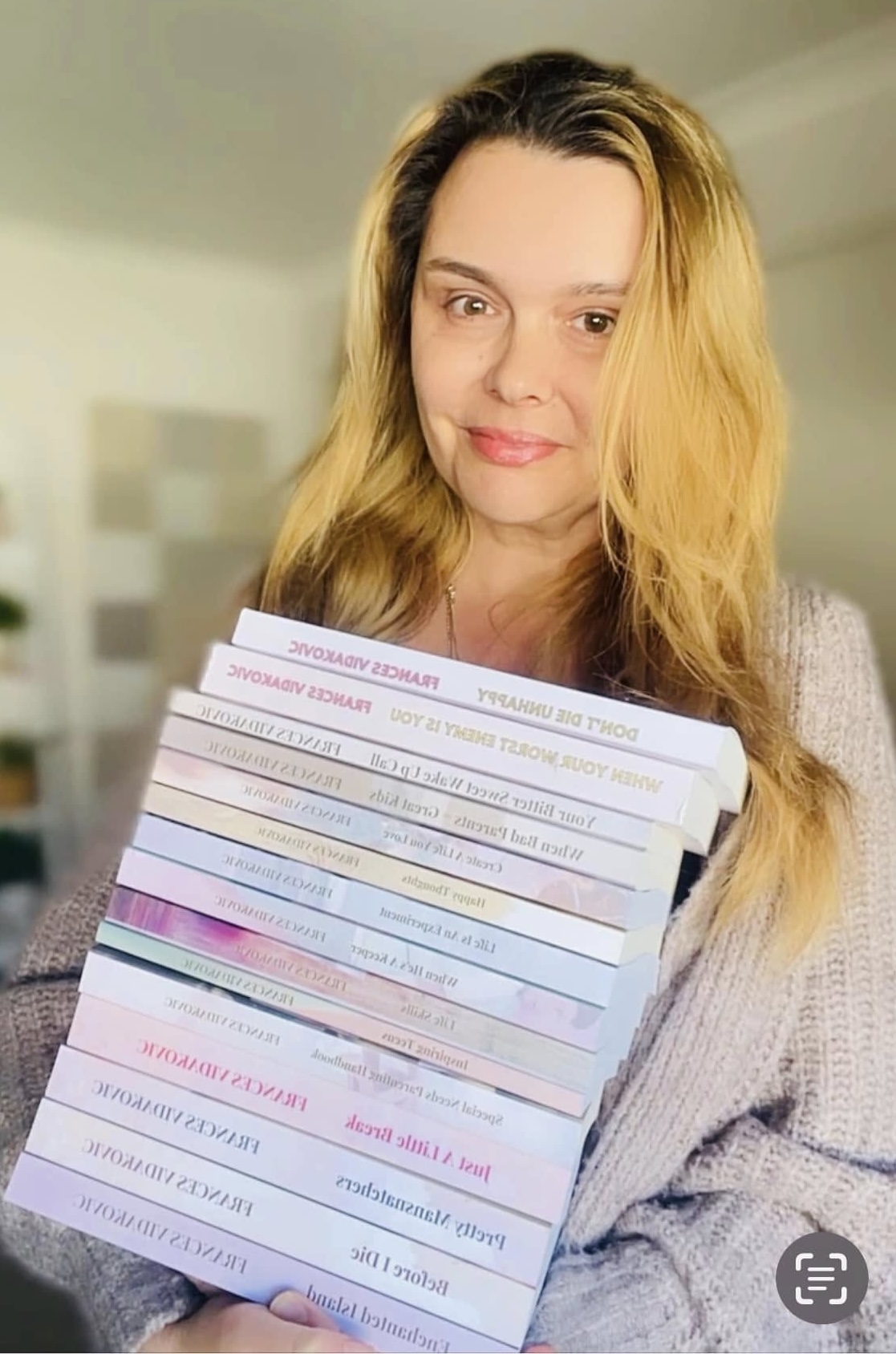
If writing a book has been sitting on your bucket list for years, I hope this article serves as proof that it is possible.
I’ve published over 25 books, not because I’m particularly special or gifted. But simply because I was willing to keep showing up, keep learning and keep writing.
And if you’d like a little extra help getting your own book out of your head and onto paper, I also created a course called How To Write A Book In 30 Days.
Inside, I walk you through the exact process I use to plan, write and finish books without overthinking every step.
You can learn more about it here.
And who knows? Hopefully this will be the year you finally stop saying, “One day I’d love to write a book” and actually start writing it. It’s definitely possible!
With love, Frances xxx
Ready to take the next step?
MANAGING YOUR MIND MASTERCOURSE
Learn how to manage your mind when your thoughts feel messy, question the stories your brain is telling you and reframe your thinking in ways that help you feel stronger, calmer and more in control.
→ Learn more about Managing Your Mind
YOUR MAGIC WAND
My private 12 week coaching process replicated as a course. Learn how to coach yourself through the things keeping you stuck so you can get out of your own way and create the changes you want in your life.
INSPIRING LIFE ACADEMY
Want everything? Get both of the courses above plus 110+ more courses and coaching roadmaps covering mindset, goals, relationships, business, parenting and more – all inside one lifetime personal growth library.
→ Explore Inspiring Life Academy

Hey, I’m Frances Vidakovic! I help you live a richer, lighter life while pursuing dreamy goals – without sacrificing your soul, sanity or family life. 🫶🏻 Author. Coach. Course Creator. DON’T DIE UNHAPPY! → Wake up. Do what matters. Savour it all 🌷