

Read This Before You Believe Another Pinterest Success Story
There’s something I’ve been wanting to say about Pinterest for a while now.
Because when you know something is potentially misleading people, it feels a little wrong to stand by and not say anything.
So here I am, saying it.
I’ve been using Pinterest for a LONG time.
I’m talking since the BoardBooster days, if anyone here is old enough in the online business world to remember those.
Pinterest was also a huge part of the early success of my business.
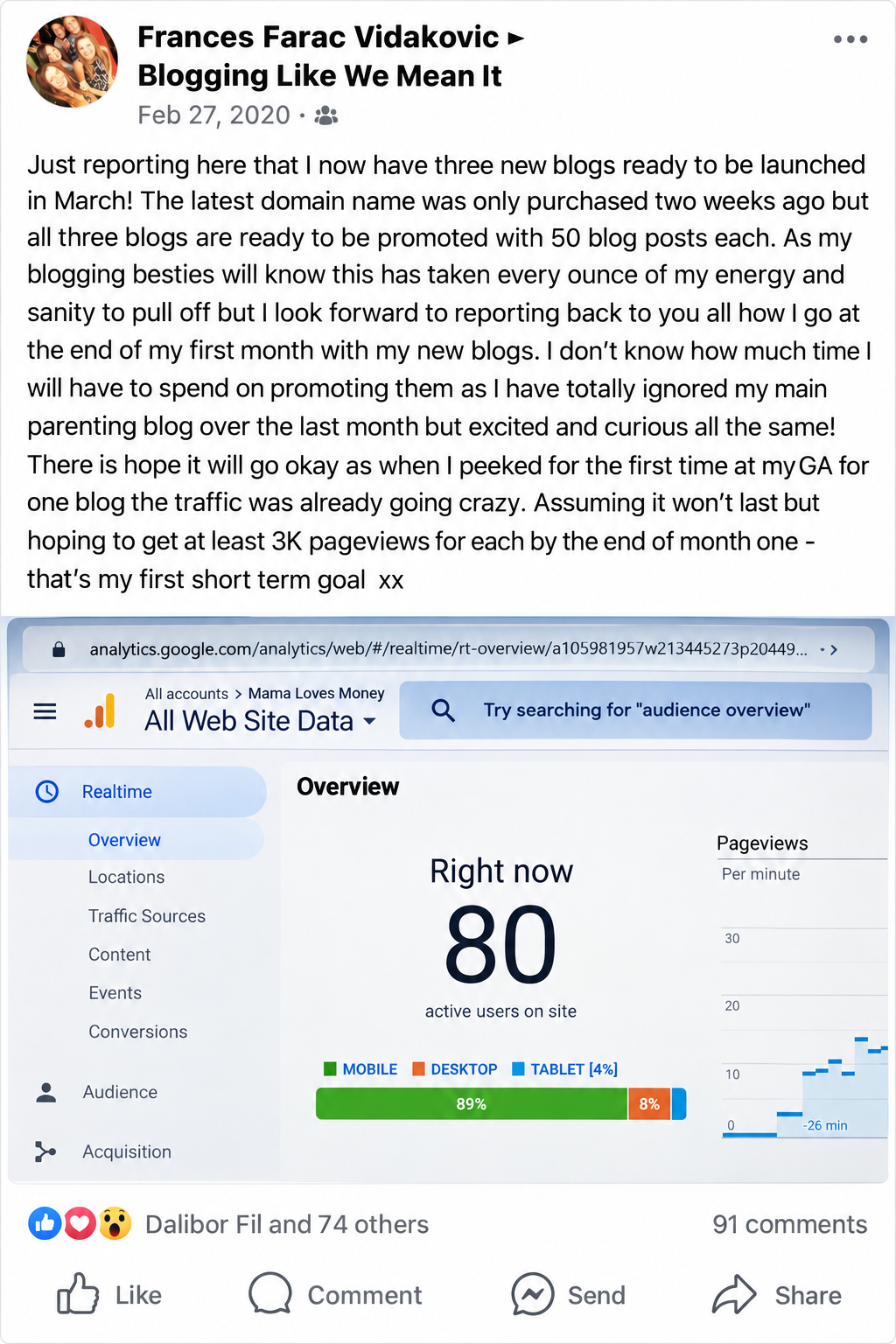
It helped me generate my first million page views in my first year of blogging and, over the years, has been responsible for more than 10 million page views to my website since then.
At my peak, Pinterest was sending hundreds of thousands of page views to my website every month.
I’ve shared screenshots and proof of those numbers in the past.
And I would apply the same strategies to the multiple websites that I launched.
So while I definitely don’t claim to know everything there is to know about Pinterest today, I do know quite a lot about generating actual traffic from the platform.
And there are a few things I think people need to understand when they see Pinterest success stories online.
Because one thing I REALLY want people to become better at is thinking critically about the numbers they see presented online.
Not because I want you to be a cynical party pooper. But because we need to become more discerning critical thinkers. And there’s a difference between the two.
First: please stop being overly impressed by millions of Pinterest impressions
I see this number used as proof of Pinterest success all the time.
“I got one million Pinterest impressions!”
“Five million impressions!”
“Ten million impressions!”
And yes, it sounds incredibly impressive.
But you need to understand what that number actually means.
Back in my Pinterest heyday, when Pinterest was sending hundreds of thousands of page views to my websites every month, I went to visit a friend.
Her daughter, who was about 13 at the time, proudly told me she’d reached one million Pinterest impressions.
And this is where I share with you that she wasn’t running a business.
She wasn’t a Pinterest strategist.
She was simply a young, excited teen, using Pinterest like a normal person and saving super popular Pins she liked to her boards. Those Pins were getting seen. And surprise, surprise, those views contributed to the impressions on her account.
That’s the first thing I want you to understand.
If somebody is showing you enormous Pinterest impressions, look at their account.
Are the Pins generating those impressions actually theirs?
Because if an account is filled with popular Pins created by other people, those impressions don’t mean Pinterest is sending all those people to that person’s business.
The Pins are simply being seen.
Those eyeballs might be landing on Pins sitting on their boards, but if those Pins belong to other creators, the traffic generated by those Pins is going somewhere else.
In fact, once my own Pinterest account was well established, I eventually removed Pins that weren’t mine from my boards.
I wanted the numbers I was personally seeing in the backend analytics dashboard to be representative of the reach of my own content.
That doesn’t mean there can’t be benefits to curating relevant content, particularly when you’re establishing an account and helping Pinterest understand what your account is about.
(In fact this is what I recommend newbies to do to kickstart their account to let Pinterest know what they are about – and you can remove those pins later because they technically aren’t your content).
But if somebody is using millions of impressions as evidence of how much traffic Pinterest is generating for their business, I want to know how much of that content is actually theirs.
Because those are two very different things.
So what number should you care about?
If we’re talking about using Pinterest as a tool to grow a business, I’m much more interested in outbound clicks.
Because an impression tells me somebody saw a Pin.
An outbound click tells me somebody actually LEFT Pinterest.
That’s a very different thing and technically outbound clicks is the only metric that truly matters.
So if somebody tells me Pinterest is generating huge amounts of traffic for them, outbound clicks are one of the first things I’d want to see.
Because people can tell you whatever number they like.
That doesn’t necessarily mean they’re lying.
But until you’ve actually seen the evidence, what you have is a claim.
And even then, I’d keep asking questions.
-
Where are those outbound clicks going?
-
Are they going to that person’s own website?
-
Their blog?
-
Their Substack?
-
A landing page?
-
A product?
-
Somewhere else entirely?
Because there are layers to these numbers.
A million impressions doesn’t equal a million website visitors.
A million impressions on your own Pins still doesn’t mean a million people clicked them.
And even a large number of outbound clicks doesn’t automatically tell us what those visitors did once they arrived at their destination.
This isn’t about being cynical.
It’s about understanding what the numbers actually prove.
And this applies to SO much more than Pinterest
I think this is something we all need to get better at online.
Critical thinking.
Someone can tell you they generated $100,000 from something.
Maybe they did. But unless you’ve actually seen evidence of it, what you have is a claim.
And even when somebody DOES provide evidence, ask yourself:
What does this evidence actually prove? Is this pure profit or just revenue?
That’s the question I wish more people would ask.
A screenshot of one metric doesn’t necessarily prove the conclusion somebody has attached to it.
And of course, that doesn’t automatically mean they’re lying.
It simply means you need to understand the metric before allowing yourself to be persuaded by it.
Don’t automatically believe a number just because somebody puts it in a pretty graphic.
Put your detective hat on.
But traffic alone isn’t the goal either
Here’s another lesson I learned the hard way.
In my first year of blogging, I had around a million page views to my website.
Amazing, right?
Except I made the mistake of not even building an email list during that time. 🤦🏻♀️
I was earning great advertising income from those visitors, so the traffic certainly wasn’t worthless.
But eventually I realised something that seems painfully obvious to me now:
I didn’t just want people to visit my world. I wanted to give them a reason to stay in it.
So I very quickly got much smarter about what happened AFTER somebody clicked one of my Pins.
If they landed on one of my blog posts, I didn’t want them to simply read it, close the tab and disappear forever.
I wanted to capitalise on the traffic I was already getting.
So I started creating generous lead magnets, often specifically related to the article they were already reading.
If you were interested enough in a particular topic to click through and read an article about it, there was a good chance you’d also be interested in a useful free resource that helped you take the next step.
I made it incredibly easy for readers to join my email list.
And that turned my Pinterest traffic into leads and subscribers.
And once someone joined my email list, they entered my funnels.
Those funnels introduced them to my courses.
Over the years, more than 10,000 students have taken my digital courses.
Now obviously I’m not suggesting every one of those students originally found me through Pinterest (I later became excellent at SEO too).
But Pinterest was definitely an important part of the ecosystem that grew my audience and business.

And that’s why, if you’re thinking about using Pinterest today, I wouldn’t stop at:
How do I get more Pinterest impressions?
I wouldn’t even stop at:
How do I get more outbound clicks?
I’d keep going.
What happens AFTER they click?
Because 100,000 people visiting your website and disappearing isn’t necessarily more valuable to your business than 10,000 highly relevant people arriving and a meaningful percentage deciding they want to hear from you again.
That’s the bigger business question we need to be solving ASAP. How do you get the right people to not just find you but want to stay in your world?
If I were using Pinterest specifically to grow a Substack today, I’d be thinking about exactly the same pathway.
Pin → article is only the beginning.
I’d be asking:
How do I turn that reader into a free subscriber?
Because just because they stumble onto your article doesn’t mean they will subscribe.
And then:
How does that free subscriber eventually discover enough value here to want to become a paid subscriber?
Even though Substack is different from blog posts published on your website – it’s a different platform and different business model – it’s still the same fundamental principle.
Don’t just chase traffic.
Build a pathway for the right people to stay.
Pinterest can absolutely generate enormous amounts of traffic
I don’t want this article to give you the impression that I think Pinterest numbers are meaningless or that Pinterest isn’t worth using.
Quite the opposite.
Pinterest can generate an extraordinary amount of traffic.
I know because I’ve experienced it firsthand.
But here’s something else I learned over my many years using Pinterest successfully:
Not every Pin takes off (not even close).
Pinterest can be a numbers game. You can create a lot of Pins that do very little. Some will be stagnant. Some will perform reasonably well.
And then occasionally you can have one take off like crazy.
When that happens, it can generate an enormous amount of traffic.
That’s also why I wouldn’t look at one viral Pin and automatically assume somebody has cracked some magical Pinterest formula.
I’m more interested in what happens consistently over time.
So what actually helped me succeed on Pinterest?
It’s the same answer I give for why anything I do has worked: experimentation.
Honestly, I think one of the biggest reasons Pinterest worked so incredibly well for me over the years was my willingness to experiment.
-
I tried things (gosh I did soooo many crazy experiments!).
-
I would watch what happened.
-
I paid attention to what worked.
-
I created more of what worked.
-
I stopped doing the things that didn’t.
-
I adjusted and then I experimented again.
And I NEVER assumed that just because somebody else had success doing something a particular way, the exact same thing would automatically work for me.
That’s probably one of the biggest lessons I could give you about Pinterest.
Use other people’s success as information, not as a guarantee.
What works beautifully for somebody else might not work for you.
And what doesn’t work for them might turn out to work brilliantly for you.
You have to be willing to give things a go and collect your own evidence.
But there are some Pinterest basics that have always mattered
There are a few fundamentals that have held true throughout all my years of using Pinterest.
Pinterest is essentially a visual discovery and search engine.
Which means you need to think about what people are actually searching for.
Before you create 100 Pins about something, ask yourself:
Would somebody actually go onto Pinterest looking for this?
Think about how YOU use Pinterest.
-
What do you type into that little search box?
-
What catches your eye when the results appear?
-
What makes you click one Pin instead of the twenty others sitting around it?
That’s Pinterest 101. Your Pin graphic matters. A LOT.
Your title and description also matters.
Your keywords matter.
Understanding Pinterest SEO matters.
And your heading needs to give somebody a compelling reason to click.
Not clickbait but click-worthy (there’s a difference).
Your Pin is competing for attention against everything else on that screen.
So you need a visually pleasing graphic that catches someone’s eye combined with a genuinely interesting heading that makes the right person think:
Ooh. I want to read that.
And it needs to be attached to something people are actually searching for.
Then you experiment.
-
Different graphics.
-
Different headlines.
-
Different topics.
-
Different keywords.
-
Different approaches.
Some will flop. Some will do okay.
And occasionally something can take off in a way you never expected.
That’s the nature of Pinterest.
And please give Pinterest enough time to actually work
This is another thing I think people sometimes get wrong.
You can’t post a handful of Pins for a few weeks, see very little happen and conclude:
Pinterest doesn’t work for me.
There is a learning curve. You’re planting seeds.
Pinterest needs time to understand your account, understand your content and start figuring out who might be interested in it.
I’ve heard people compare building a Pinterest account to the lifespan of a baby – give it nine months of planting those seeds and seeing what grows.
I’m not saying there’s some magical nine-month mark when everything suddenly takes off.
There isn’t. But I DO think you need to approach Pinterest as a longer-term experiment rather than expecting immediate gratification.
And that’s also one of the things I’ve always loved most about Pinterest.
A Pin can have an incredibly long lifespan.
This isn’t necessarily like posting something on social media, getting a little burst of attention and watching it disappear down the feed.
I still have Pins generating traffic for me YEARS after I originally created them.
That’s work I did years ago that can still send people into my world today.
And when a Pin really takes off, you can sometimes ride that wave for a very long time.
That’s the beauty of planting those seeds.
Some won’t grow. Some might take months to do anything particularly exciting. And some can become little traffic-generating machines that keep working for you long after you’ve moved onto creating something else.
So if I were starting Pinterest from scratch today…
If Pinterest was something I genuinely wanted to test as a traffic strategy specifically for Substack today, I’d personally commit to giving it at least three to six months of consistent effort before drawing any major conclusions.
And if I were starting from scratch, I’d probably aim for around five fresh Pins a day to begin with.
If I had the capacity to experiment with more, I might work my way towards ten.
But I’d rather consistently create five good fresh Pins than set myself some ridiculous target I couldn’t sustain.
Initially, I’d focus on fresh Pins.
I’d create. Watch. Learn. And study my analytics.
-
Which topics are getting impressions?
-
Which graphics are getting attention?
-
Which headlines are earning clicks?
-
Which keywords seem to be working?
And most importantly:
Which Pins are actually generating outbound traffic?
Once I had established the account and started getting some traction, I’d then experiment with repinning some of my own Pins and see what happened.
But please understand: This is what I would test.
It’s not some magical Pinterest formula I’m promising will work for everybody.
That’s the entire point. Experiment. Gather evidence. Pay attention. Adjust. And give those seeds enough time to grow before deciding the garden is dead.
Pinterest also isn’t necessarily right for every niche
This matters too. There are niches that have historically been incredibly well suited to Pinterest.
-
Food and recipes.
-
Home decor.
-
Parenting.
-
Personal development.
-
Certain areas of business.
-
And plenty of others.
But before deciding Pinterest should become a major part of your marketing strategy, I’d do some investigating.
Go onto Pinterest. Search for the kind of content you would be creating.
Look at the accounts already operating in your space.
-
Are people searching for this stuff?
-
Are there Pins covering these topics that are clearly performing?
-
Are the successful Pins actually owned by those creators?
-
Where are those Pins leading?
-
Is there evidence that Pinterest is genuinely being used to discover this kind of content?
Again: Put your detective hat on.
You don’t need somebody on the internet to give you permission to test Pinterest.
Go and investigate the platform yourself.

Was it easier when I started?
Possibly. Actually probably yes. I think it’s only fair for me to acknowledge that. I started using Pinterest seriously many years ago when there was less competition on the platform.
Just as someone who started on Substack years ago may have had advantages that somebody starting today doesn’t have.
Sometimes people look at a platform now and think:
-
It’s too saturated.
-
I’ve missed the boat.
-
Everyone is already there.
But I don’t think that’s necessarily a particularly useful reason to dismiss a platform.
There are creators using Pinterest today who are absolutely killing it.
And some of the most interesting ones aren’t selling Pinterest courses.
They aren’t positioning themselves as Pinterest experts.
They aren’t necessarily even talking about how successful they are on Pinterest.
They’re simply using Pinterest extremely well to get their own content discovered and drive people to their websites and businesses.
Those are actually some of the accounts I’d be most interested in studying.
Not because I want to blindly copy what they’re doing.
But because I want to understand it.
-
What are they creating?
-
What topics consistently perform?
-
What do their Pins look like?
-
What headlines are getting attention?
-
How frequently are they creating?
-
Where are those Pins leading?
-
What can I learn from what’s already working?
And then I’d take those observations back to my own business and experiment. This is what I mean by having your detective hat on.
Because that’s how I became successful with Pinterest in the first place.
Not because somebody handed me a magical Pinterest formula.
I was willing to test, pay attention and keep adjusting.
So why am I not currently using Pinterest heavily myself?
This is probably the obvious question.
If Pinterest generated more than 10 million page views for me over the years, why am I not still going all-in on it?
Because my business model has changed over the last few years.
My current Pinterest account has around 24,000 followers and was built during the years when blogging was a major part of my business.
Pinterest made enormous sense for me then.
All that traffic was incredibly valuable to me because my business model was built around getting people onto my blogs.
First there was advertising income. If people simply came to my website and read an article of mine, I got paid yay. If the article had affiliate links to useful products and they clicked through, I got paid even more.
Then I got smarter and started converting those visitors into email subscribers.
Then those subscribers entered my funnels and those funnels introduced them to my paid offers (I have created over 100 courses and coaching roadmaps in my business and had over 10,000 students to date).
Pinterest in those early years had a very clear job within my business.
But over time, my business changed and sigh, the blogging landscape definitely changed. AI changed the way people find information online but thankfully I had already moved into other forms of lead generation (mainly via my Inspiring Life School podcast and participation in bundles and summits – the quality of those leads was so much higher).
But there’s another important reason I haven’t simply taken my established Pinterest account and started using it heavily for Your Richer Life.
The audience and content are different.
Pinterest has spent years learning what my established account is about (initially a parenting blog) and who is interested in that content.
Suddenly changing direction would be a little like building a YouTube channel about money and then announcing that you’re now going to upload cooking videos.
Yes, technically you have an established audience.
But it’s not necessarily the RIGHT audience.
And you risk confusing both the audience and the platform.
So if I decided I genuinely wanted to test Pinterest as a growth strategy for Your Richer Life, I’d actually be more inclined to start a fresh account.
Yep I would say bye bye to my 24,000 follower and historical advantage and just do an experiment where I start from scratch.
And honestly? I may just do that and I’d be curious to see what happens.
Which brings me back to the thing I really want you to take away from this
The whole point of me writing this article was to encourage you to please be discerning when people present impressive-looking numbers online.
I’m not saying you need to be cynical or suspicious of everyone.
Just curious enough to ask:
What does that number actually measure?
Me as an longtime Pinterest user for my business already knows what numbers matter and which don’t.
If someone tells you they have millions of Pinterest impressions, look at their account.
Are the Pins actually theirs? And if someone tells you Pinterest is sending them enormous amounts of traffic, I’d want to see the metric that actually shows people leaving Pinterest:
Outbound clicks.
And even then, keep going.
-
Where are those clicks going?
-
Are they going somewhere that person owns?
-
Are those visitors turning into subscribers?
-
Leads?
-
Customers?
-
Revenue?
The goal is to build something that actually moves your business forward.
ONE IMPORTANT NOTE ABOUT OUTBOUND CLICKS
Back in the blogging days, we also cared a LOT about our bounce rate in Google Analytics.
It wasn’t enough to know how many people landed on my website. I also needed to pay attention to what they did once they got there.
Were people clicking through and immediately disappearing? Or were they sticking around, reading more and exploring my site?
Getting traffic is of course great, but if people land on your website, think your content sucks and leave straight away, that’s not so great.
I wanted that traffic to actually do something – ideally sign up to my email list so we could stay connected.
And in terms of Substack, the goal would be similar: you don’t just want someone to click through and read your article. You want them to love what they find enough to think, “Yep, I want more of this,” and subscribe.
Anyway, the point of this article isn’t to poo-poo Pinterest. Quite the opposite. I absolutely LOVE the platform and know firsthand just how powerful it can be when you understand how to use it well.
But if you’re wondering whether Pinterest could work for YOU, you really do need to put on your detective hat.
In a nutshell do the following:
-
Look at your niche.
-
Look at what’s already performing well on Pinterest.
-
Look at whether their successful Pins are actually their own.
-
Think about whether people genuinely go onto Pinterest searching for the type of thing you create.
-
Study what catches your own attention.
-
Then test it for yourself.
-
Give yourself enough time to learn.
-
Create enough Pins to gather meaningful information.
-
Watch what happens, follow the evidence and ddjust accordingly.
Because someone else’s Pinterest success – or failure – doesn’t automatically tell you what will happen with your business.
And that willingness to experiment was one of the biggest reasons Pinterest worked so well for me.
I didn’t know in advance which Pins would take off (I’m not a psychic).
I simply planted the seeds, watched, learned and adjusted.
And when something worked, I did more of it.
This lesson also extends far beyond Pinterest.
Look at the evidence.
Understand what the numbers actually mean.
Experiment.
Pay attention.
Adjust.
And always keep your eyes firmly on the result that actually matters to your business – the numbers that are really most important.
Because visibility is lovely. And yes, millions of impressions look fantastic on a screenshot.
But if you’re building a business:
Don’t confuse visibility with results.
Remember quality over quantity always.
Much love,
Frances xxx
Ready to take the next step?
MANAGING YOUR MIND MASTERCOURSE
Learn how to manage your mind when your thoughts feel messy, question the stories your brain is telling you and reframe your thinking in ways that help you feel stronger, calmer and more in control.
→ Explore Managing Your Mind Mastercourse
My private 12 week coaching process replicated as a course. Learn how to coach yourself through the things keeping you stuck so you can get out of your own way and create the changes you want in your life.
Want everything? Get both of the courses above plus 110+ more courses and coaching roadmaps covering mindset, goals, relationships, business, parenting and more – all inside one lifetime personal growth library.
→ Explore Inspiring Life Academy

Hey, I’m Frances Vidakovic! I help you live a richer, lighter life while pursuing dreamy goals – without sacrificing your soul, sanity or family life. 🫶🏻 Author. Coach. Course Creator. DON’T DIE UNHAPPY! → Wake up. Do what matters. Savour it all 🌷